

Sri Lanka 1000 Rupees Commemorative Banknote 2009: Unity, Victory, and a Defining Moment in National History
The Sri Lanka 1000 Rupees Commemorative Banknote issued in 2009 occupies a unique place in the country’s modern numismatic history. Authorized under Section 52A (1) (a) and (b) of the Monetary Law Act (Amendment) No. 6 of 1998, and released with the approval of the Minister of Finance, this note represents the second commemorative banknote ever issued by the Central Bank of Sri Lanka. It was conceived to mark a decisive and emotionally charged chapter in Sri Lanka’s post-independence narrative: the restoration of national unity after decades of internal conflict.
Sri Lanka’s first commemorative banknote was issued in 1998 to celebrate the 50th Anniversary of Independence. In contrast, the 2009 issue was not tied to a round-number anniversary but to a historic turning point—the end of the long-running civil conflict and the reassertion of territorial integrity. This context gives the note a distinctly political, military, and symbolic character, reflecting both triumph and transition.
Historical Context and Commemorative Purpose
The banknote was issued shortly after the conclusion of military operations in 2009 that brought an end to the armed conflict. At the time, Mahinda Rajapaksa served as President of Sri Lanka and also held the portfolio of Minister of Finance. His leadership during this period made him a central figure in the state’s narrative of unity, sovereignty, and national revival. The commemorative note was therefore designed not merely as currency, but as a visual statement of state authority, reconciliation, and future-oriented optimism.
Obverse: Leadership, Unity, and Prosperity
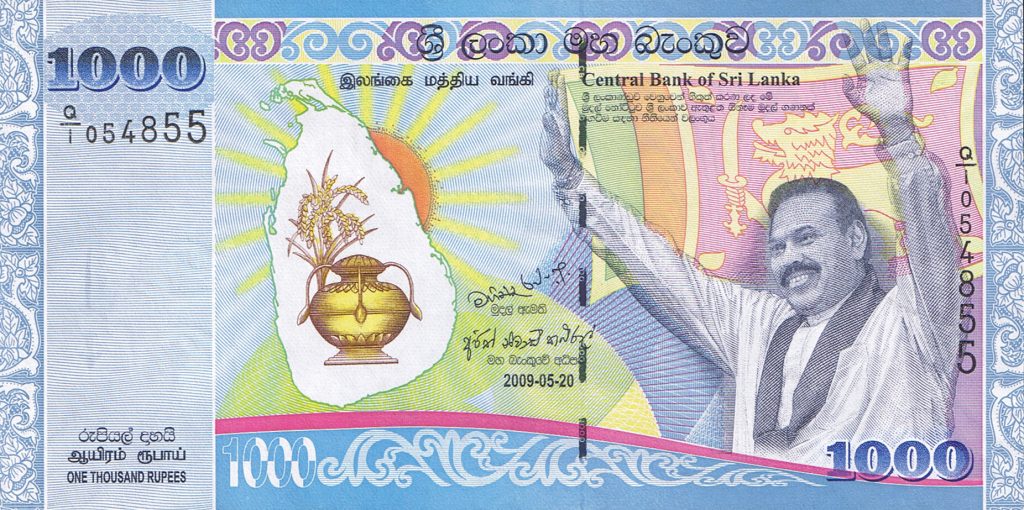
The obverse of the note carries the theme “one country and one nation in harmony, progressing towards prosperity.” Dominating the right side is a portrait of President Mahinda Rajapaksa, depicted raising his hands in a gesture that suggests victory, confidence, and popular mandate. His image anchors the message of centralized leadership guiding the nation through a critical juncture.
To the left of the portrait appears a map of Sri Lanka, backed by a rising sun. This combination symbolizes renewed hope and the dawn of a unified future following years of division. Positioned prominently at the center-left is the “Punkalasa”, a traditional pot overflowing with ears of paddy. In Sri Lankan cultural symbolism, the Punkalasa represents abundance, fertility, and prosperity. Together, these elements visually connect peace and harmony with economic renewal and agricultural sustenance—core pillars of national well-being.
Reverse: Tribute to the Security Forces
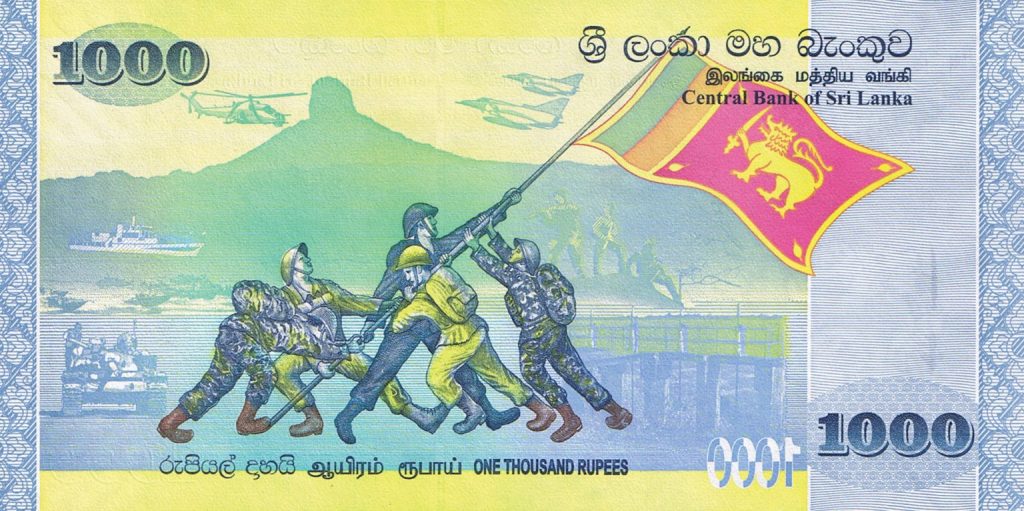
The reverse side of the banknote shifts focus from leadership to collective sacrifice. Its theme honors the valiant contribution of the nation’s sons and daughters in the security forces and police. At the center is a dynamic scene depicting members of the armed forces hoisting the national flag, an unmistakable image of victory and sovereignty.
The background features two highly symbolic landmarks: the Mavil Aru anicut and Thoppigala rock, also known as Baron’s Cap. Both sites were pivotal during humanitarian operations and are widely regarded as turning points in the military campaign. Their inclusion embeds specific geographic and historical references into the design, transforming the note into a visual chronicle of national struggle and resolution.
Design, Security Features, and Technical Details
The commemorative note measures 157 mm × 78.5 mm, with blue as its predominant color—often associated with stability and authority. Each note bears the serial prefix “Q”, with numbering beginning from Q/1 000001, printed horizontally on the left and vertically on the right in Arabic numerals.
Security features are consistent with contemporary Sri Lankan high-denomination notes. These include a watermark depicting the heraldic lion of Sri Lanka, with the sword highlighted in a clear panel, Cornerstones similar to those on the standard Rs. 1000 note, a 1.2 mm wide windowed clear-text security thread, exact-registration see-through elements, and invisible fluorescent printing. Collectively, these features reinforce the note’s status as legal tender while protecting it against counterfeiting.
The note bears facsimile signatures of President and Minister of Finance Mahinda Rajapaksa and Ajith Nivard Cabraal, Governor of the Central Bank, dated 20 May 2009.
Issuance and Numismatic Significance
The official presentation took place on 17 November 2009 at the John Exter International Conference Hall in Colombo, where the Governor of the Central Bank formally issued the note to the President. A limited number of early-serial notes were released in special presentation folders, priced at Rs. 1,500, targeting collectors and institutions.
Crucially, the note was declared legal tender for all payments in Sri Lanka and remains a liability of the Central Bank while in circulation. Its dual status—as both commemorative artifact and circulating currency—makes it especially significant. Unlike medals or non-circulating notes, this banknote carried its historical message directly into everyday economic life.
In retrospect, the 2009 Sri Lanka 1000 Rupees Commemorative Banknote stands as a powerful document of state memory. It reflects how currency can function not only as a medium of exchange, but also as a vehicle for political narrative, collective identity, and historical interpretation at a defining moment in a nation’s journey.